Showing posts with label blog. Show all posts
 

Some great Italian wines for a good price

Let’s think about good things. This post responds to the wide request for advice on the subject and reflects my personal opinion. So, I suggest 3 wines with an extraordinary price-quality ratio: 

🍷 Dolcetto di Dogliani - Piemonte, great bottles for under 20€

🍷 Amarone - Veneto the price varies a lot, but you can find excellent bottles for 40

🍷 Brunello di Montalcino - Toscana, great bottles for 15 - 40


Moreover, I got the following 5 tips from a very generous Twitter follower from Sweden:
 

🍷 Vino Nobile di Montepulciano

🍷 Chianti Rufina

🍷 Roero Rosso - the best Nebbiolo for under 20€ 

🍷 Etna Rosso - a very special wine from slopes of Mount Etna, reminiscent of a Bourgogne, 15-25€ 

🍷 Montefalco Sagrantino - needs some age and expect to pay around 30€, but this is often overlooked when Italian greats are discussed


Here the Tweet: 


stampa la pagina
 

Essere cotto/a & Avere una cotta


🍳 Essere cotto/a = to be exhausted (literally: to be cooked)


Stasera non esco perché dopo la palestra sono cotto 

I'm not going out tonight because I'm exhausted after the gym


💘 Avere una cotta = to have a crush 


Marco ha una cotta per Lucia 

 Marco has a crush on Lucia


(also "essere cotto + di": Marco è cotto di Lucia)

stampa la pagina
 

Hair: pelo o capello?


Hair = Pelo (any hair except those on the head) 

Hair = Capello (just those on the head) 

"Capello" probably comes from the Latin words 'caput' & 'pilus' meaning respectively 'head' & 'hair', jointed in 'capillus'.


In English the word "Capello" is present in the term "Capillary" (Capillare) which originally meant "pertaining to hair". However, “Capello” should not be confused with:

Cappello (2p) = Hat 
 
or

Cappella = Chapel


stampa la pagina
 

Poems on the walls of Rome

Rome is full of creativity, especially regarding the use of the local language. Most of the graffiti is in 'Romanesco' and often you can read actual poems on the walls. 

The one in the picture reads: "I got rhimes in my head / a storm in my heart" by Er Pinto


stampa la pagina
 

Aragosta o Astice? Guarda se ha le chele!

Se vuoi dire "Lobster" in italiano, devi fare un po' di attenzione e soprattutto notare la presenza delle chele (claws)

Lobster = Astice (with claws) 
Spiny lobster / langouste = Aragosta (no claws)

Nel quadro puoi vedere un crostaceo con le chele, quindi dovrebbe essere un 'astice' o persino un 'gambero d'acqua dolce' (freshwater crayfish)

IT: Ehi, ti sei dimenticato l'aragosta sul tavolo! 
EN: Hey, you forgot your lobster on the table!


Immagine:  Still Life with Lobster (Larionov, 1907) da Wikimedia Commons

stampa la pagina
 

First listening practice: go beyond the meaning

Tip for increasing your Italian listening skills: for some time go beyond the meaning. Don't try to get any info. Just focus on the rhythm & breaks. On the breaths. Identify where sentences start and end, then do it for words. Repeat until you are familiar with most of the sounds.

Once you can do this without feeling stressed (ideally to the point that you can do it to relax) bring back the meaning to what you hear and see if it fits the sounds better.
stampa la pagina
 

Grape in Italian: Uva, Acino or Chicco d'uva?

"Uva" is a singular noun that corresponds to the English plural "Grapes", referring to the whole bunch of fruit

For one singular "Grape", in Italian you say "Acino" or "Chicco d'uva". 

“Acino” is actually the correct term for a singular grape, but it may sound a bit too formal for the everyday language. 

“Chicco d'uva” instead is a locution that sounds more easy going, especially for kids. “Chicco” also generally means grain. 

The plural "Le Uve" means more bunches of grapes or grape types. 

The Italian equivalents for the idiom “Hearing things through the grapevine” have nothing to do with grapevine (vigna). But very informally you may bring up a “uccellino”:

Me lo ha detto un uccellino = “I was told that by a little bird” 

stampa la pagina
 

Why is Football called " Calcio " in Italy?

 
⚽️ "Calcio" in Italian means both the chemical element calcium (Ca) and "kick".


From this second meaning we therefore have "Football / Soccer" because in this sport you basically have to give "un calcio al pallone" 


The verb is:
to kick = calciare


Image: Durante - Football Club Juventus Association, 1903 
from Wikimedia Commons
 
 
stampa la pagina
 

The capitals of Italy

Italy had 3 cities as its capital: 

  • 1 Turin (1861-65) as the capital of the kingdom that led the unification of the country 

  • 2 Florence (1865-71) because it has a more central position on the Italian territory 

  • 3 Rome (since 1871) after it was taken militarily from the Pope

stampa la pagina
 

An inscription in Neapolitan

Neapolitan language is commonly used by the people of Napoli of all ages. You can see it in the inscription on the wall in the picture 👉

The sentence means: Love (the heart) has no master. Note the difference with Italian. 


  • 🔵 'O core nun tene padrone 
 
  • 🇮🇹 Il cuore non ha padrone   


stampa la pagina
 

Italy has so many languages!

🌈 🇮🇹 Although it may not appear obvious, dialects are not a corrupted and local version of Italian; each of them is actually a language that developed from Latin independently. 


stampa la pagina
 

Not only a "gesto"

🇮🇹“Gesto” is not only 🇬🇧“gesture” (1) a movement of the body (esp. hands). With a symbolic extension, it can also mean 🇬🇧“deed, action, enterprise” (2). 

⚠️ Same singular, slightly different plural:
  • 1. Senza parlare, ci capivamo con dei GESTI
  • 2. Omero narrò le GESTA di Ulisse

stampa la pagina
 

Italian has few vowel sounds

Phonetically, Italian has very few vowel sounds, only 7, while English (RP) has 12. But italian vowels should always be clearly pronounced, with no slur or fade. Italian also relies a lot on their sound to avoid clusters of consonants, up to these cases:

AIUOLE = Flowerbeds 🌸
CUOIO = leather 💼


Although you may only read: A E I O U, actually these are the sounds you hear:


stampa la pagina
 

Succedere as "to happen" & "to suceed"

"Succedere" basically means coming after in time/space. It translates both "to happen" & "to suceed somebody/something", diversifying only their past participle:

🇮🇹 Cos'è SUCCESSO?
🇬🇧 What happened?

🇮🇹 Edoardo è SUCCEDUTO alla regina Vittoria
🇬🇧 Edward succeeded Queen Victoria
stampa la pagina
 

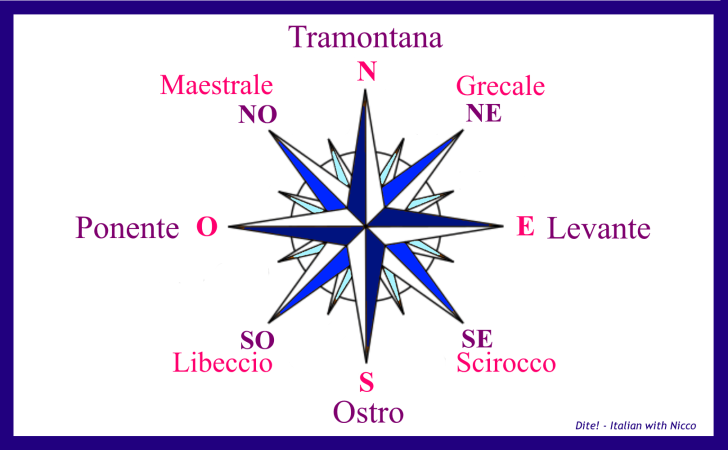
The Compass Rose (la Rosa dei Venti)

The Compass Rose (la Rosa dei Venti) makes more sense if placed in the center of the Mediterranean Sea. Here the provenience of the winds matches the meaning of their original Italian-sounding names. 🌬️

  • Tramontana from the mountains
  • Grecale from Greece
  • Levante synonym of Oriente
  • Scirocco from Syria
  • Ostro from the word "Austro" meaning South (as in Australia = Southern Land)
  • Libeccio from Libya
  • Ponente synonym of Occidente
  • Maestrale from Rome as “Magistra Mundi”

stampa la pagina
 

The meaning of Jeans & Denim

Fabrics used to be named after the place of their production.
  • Jeans was how the city of Genoa (Genova) was called in the 16th c.;
  • Denim sounds in French "de Nîmes" which means from Nîmes where weavers reproduced the fabric used by the Genoese Navy to equip its sailors
stampa la pagina
 

Handle your accent with irony!

My phone has a bit of an accent 😂!
Irony apart, when you practice a language focus on providing a clear message, rather than struggling with a fake native pronunciation. As long as your voice meets the basic phonetic rules, there's no need to hide who you are and where you're from!
stampa la pagina
 

Origin of the "montagne russe"

Roller coasters originated in Russia in the 17th century. They were ice tracks for sleds built on hills or wooden structures. That's why in many Roman languages they are:
  • ITA: Montagne russe
  • ESP: Montaña rusa
  • FRA: Montagnes russes
  • PORT: Montanha russa

But in Russia..well, they say American Mountains!
stampa la pagina
 

Prendere un granchio o due piccioni?

While "Prendere un granchio" (to catch a crab ) means to make a big mistake, “Prendere due piccioni con una fava" (to seize 2 pigeons with 1 fava bean) means to achieve two things in a single action. Nothing wrong with that then, and the pigeons are still ok!
 
Emojis designed by OpenMoji
stampa la pagina
 

Ecco qua! = There you go!

A wonderful example to clarify the Italian expression that often translates: There you go!

Actually, here below you can read “Eccoli” where the attached “-li” refers to the figs. So, more or less, you can translate it as: There you go with them (your figs!) 
stampa la pagina